Our wash line
Four wash levels with documented records.
Guide · Practical
You have a 6-inch hole and no arm access. That single constraint dictates everything about cleaning an IBC: it is a chemical and hydraulic problem, never a mechanical one.
Order desk
Reading this because you are working something out? Send it over. We answer questions from people who are not buying anything, and we do it in writing.
Clean an IBC tote in four escalating stages: triple rinse with warm potable water for water-soluble residues; hot alkaline detergent at around 160 °F with a spray ball for oils, sugars and food residues; recirculating caustic for heavy or set residues; live steam with a vented lid for odour and biofilm. Never exceed about 175 °F, never steam a sealed bottle, and never use a turbo nozzle on the interior wall.
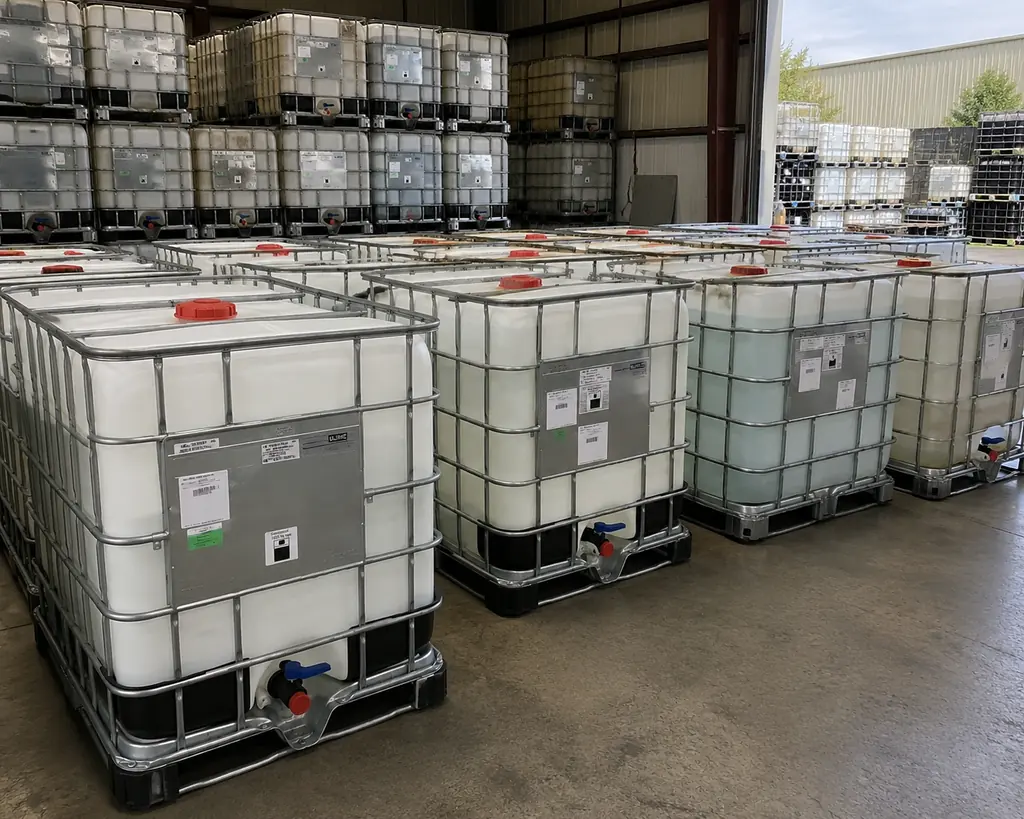
Three separate fills of roughly 10 % volume, agitated by rolling the liquid around the base, drained completely through the valve between each. The valve must be open during at least one rinse so the outlet and the ball seat see water too — that dead leg is where residues hide. Adequate for water-soluble products, dilute salts and most agricultural nutrients.
160 °F water with an alkaline detergent at label concentration, delivered through a rotating spray ball on a lance dropped through the lid. Twenty minutes of contact, then two potable rinses. This handles light oils, soaps, sugars, syrups and the great majority of food residues. Most people who think they need caustic actually need this.
A recirculating loop of hot sodium hydroxide solution, typically 2–4 %, pumped through a spray ball for 30–45 minutes and then neutralised and rinsed. This is what removes set sugars, polymer films, heavy oils and adhesives. It requires PPE, containment and a neutralisation plan; it is not a driveway job.
Live steam through the open lid with the valve open, for odour, biofilm and residual volatiles. The lid must stay off during cooldown. This is the stage that goes wrong most often, and it goes wrong in one specific way described below.
?Common questions
With a wide fan tip and moderate pressure through the lid, yes, as a supplement to chemical cleaning. With a turbo or rotating nozzle, no — it scores the wall permanently. The pressure washer is for the exterior; the interior wants a spray ball.
About 34 gallons on a 275 gallon tote if you rinse at 10 % volume three times. On our line a recovery loop cuts fresh consumption to roughly 11 gallons by cascading the final rinse of one tote into the first rinse of the next.
For a non-potable irrigation tote, a dilute hypochlorite sanitise is fine and common. Keep it under 200 ppm, rinse afterwards, and do not make a habit of high concentrations. For anything potable, use a product actually listed for potable water systems.
Below about ten totes, do it yourself at stages 1–2. Above that, or for anything needing caustic or steam, send it out — the chemistry, the containment and the effluent handling cost more to set up than the service costs to buy.
»Keep reading
Four wash levels with documented records.
When cleaning is not the answer.
The absorption problem, explained.
One form, one human, one written quote. Totes to buy, totes to sell, a wash job, a recycling pickup — it all starts here.