The numbers, published
Diversion tonnage, emission factors and the calculator behind them.
Service 03 · The end of the line
Reuse is better than recycling and we say so constantly. But a cracked bottle is a cracked bottle, and when a container genuinely reaches the end, it gets separated into its three materials and sold back into manufacturing. Nothing from this yard goes to landfill.
Order desk
Counts, ZIP and what the containers last held. That is enough for us to come back with a real number rather than a range.
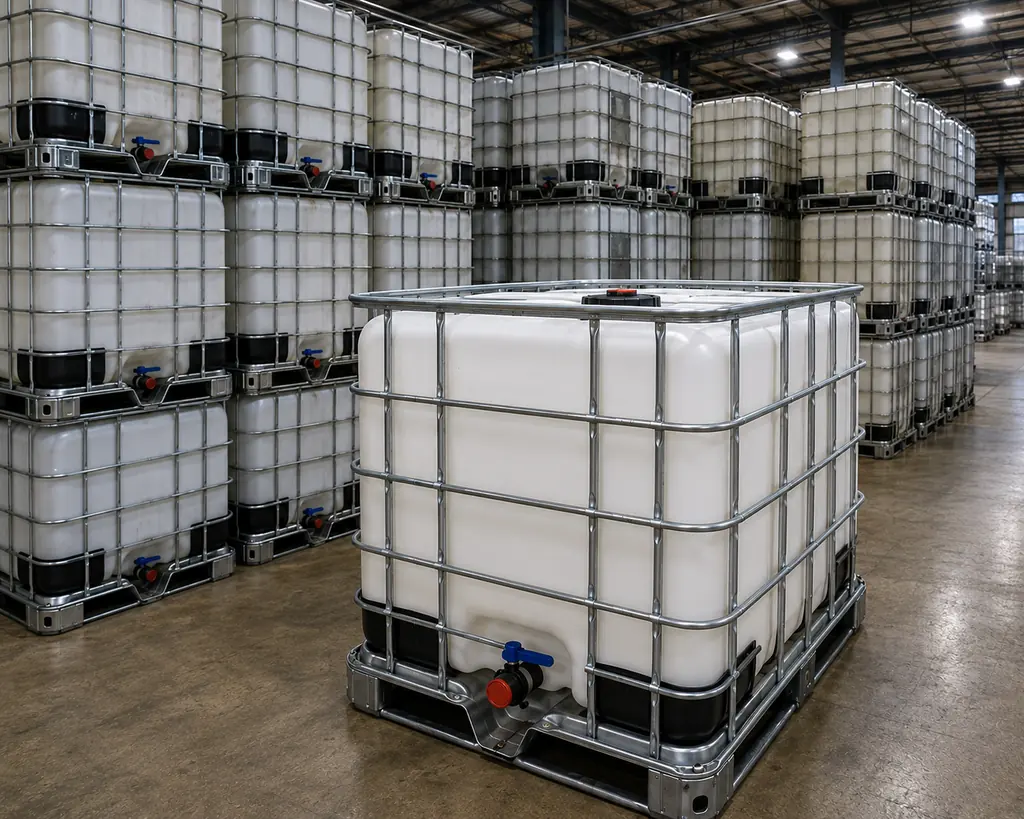
When a tote cannot be reconditioned or rebottled, we dismantle it: the HDPE bottle is granulated into regrind and sold to pipe, pallet and drainage manufacturers; the galvanised steel cage and any steel pallet are baled and sold to mill; composite and plastic pallets are ground with the bottle stream. You receive a weigh ticket per material stream and a diversion certificate stating the tonnage kept out of landfill.
| Component | Mass | Process | Destination |
|---|---|---|---|
| HDPE bottle | 39 lb | Cut, washed, granulated to 3/8" | Corrugated pipe, pallets, drainage, non-food packaging |
| Steel cage | 66 lb | Sheared and baled | EAF mill, Texas Gulf Coast |
| Composite pallet | 22 lb | Separated, ground with bottle stream | Same as bottle |
| Valve assembly | 3 lb | Rebuilt or brass/steel separated | Reuse or scrap metal |
| Gaskets, labels, residue | ≈ 5 lb | Removed and disposed | The 4 % we cannot recover |
That 4 % is the honest number. Anyone claiming 100 % recovery on a composite container is not counting gaskets, adhesive labels or residual product. We would rather publish 96 % and be believed.
Recycling HDPE is genuinely good — regrind carries roughly a quarter of the embodied carbon of virgin resin. But granulating a bottle destroys a container worth $130 to produce a commodity worth about $6, and it spends energy doing it. Reuse skips all of that.
| Route | kg CO₂e | Relative |
|---|---|---|
| New tote, virgin components | 108 | 100 % |
| Rebottled — new bottle, reclaimed cage | 49 | 45 % |
| Reconditioned — wash, rebuild, test | 13 | 12 % |
| Recycled into regrind, then remade elsewhere | 78 | 72 % |
Read that bottom row carefully. Recycling a tote and buying a new one is nearly six times worse than washing the one you have. It is the reason our sales team is instructed to talk customers down the list, not up it. The factors behind these figures are published in full on our Eco Impact page and we will happily argue about them.
?Common questions
It depends on the mix. A clean load of granulation-grade totes has positive scrap value and we pay for it. A load contaminated with residue, mixed waste or non-recoverable material costs money to process and we charge. We quote either way from photographs before anything moves.
Not through this stream. Ag chemical containers have a dedicated recovery programme and specific rinse requirements. We will point you to the right route rather than take a job we should not.
Zinc is volatilised and captured in the mill's baghouse dust, which is itself recovered for zinc production. Galvanised steel is a completely normal feedstock for an electric arc furnace — it is not a contaminant.
We take HDPE and PP in container form — drums, bins, pallets, closures. We do not take film, mixed post-consumer plastics or anything we cannot identify. A clean single-polymer stream is what makes regrind saleable.
»Keep reading
Diversion tonnage, emission factors and the calculator behind them.
Most totes people call scrap are worth reconditioning.
What we measure, what we will not claim, and why.
One form, one human, one written quote. Totes to buy, totes to sell, a wash job, a recycling pickup — it all starts here.