Inside the yard
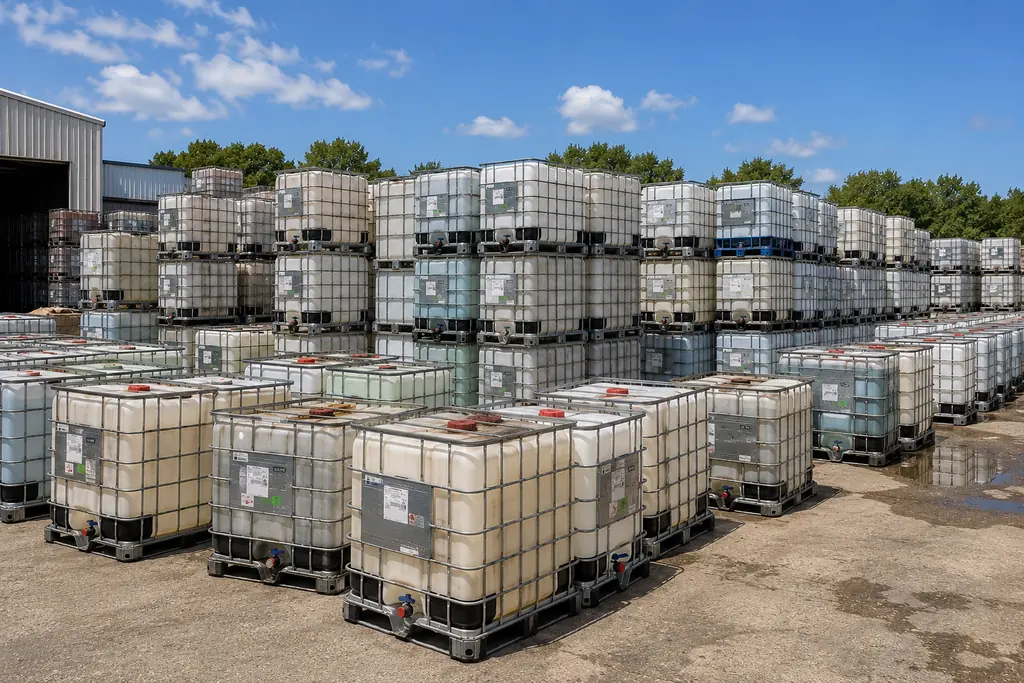
The wash line, the granulator and the rainwater array.
Est. 2009 · East Austin
IBC Totes TX exists because somebody asked to buy back the thing we had just been paid to take to the landfill. Seventeen years later that question is the whole business model.
Order desk
Buying, selling, washing or scrapping — the same form reaches the same people, and one of them has been here since the flatbed.
IBC Totes TX is a container reconditioner and recycler founded in Austin in 2009. We buy used intermediate bulk containers, wash and rebuild them, rebottle the ones whose cages outlived their bottles, haul them across Texas on our own trucks, and granulate the ones that are genuinely finished. Twenty-two people, one yard at 3505 Montopolis Drive, roughly forty thousand containers a year.
01Timeline
Including the year we got it wrong, because that is the year the grading policy comes from.
It started as a side job hauling scrap out of chemical distributors on the east side. The totes were supposed to be the worthless part of the load. After the third customer asked whether they could buy a couple back — washed — it became obvious the worthless part was the business.
A leased half-acre off Montopolis with a slab, a drain and a hot water heater bought at auction. Two people, about forty containers a week, and the first hard lesson: nobody trusts a used container unless you can tell them what was in it. The prior-contents log started that year and has never stopped.
We took a load we should not have — unlabelled, unknown, cheap. It cost more to dispose of properly than we had paid for it, and it taught us the rule we still grade by: no label, no unknown residue, no exceptions. The gate policy that annoys some sellers dates from that week.
We had a row of forty cages that were perfectly sound with bottles nobody would buy. Rather than scrap them we bought bottles. That row paid for the jig, the jig paid for the second bay, and rebottling is now a quarter of what leaves the yard.
Selling end-of-life containers to a third-party recycler meant we could never say honestly where the material went. So we bought our own granulator. It is the least profitable machine on the site and the one we are proudest of, because it is the reason we can print a destination on a diversion certificate.
Fourteen thousand square feet of roof and an eight-tote harvesting array built from C-grade stock. It supplies about a fifth of the wash line's feed water, and it is the thing customers ask about more than anything else on the tour.
Twenty-two people, four trucks, four wash bays and a fabrication shop. 41,820 containers recovered last year, 83 percent of them returned to service. Still one yard. Still the same log book, now on a screen.
02How we operate
Our sales team is instructed to talk customers down the price list. In this trade the cheap option is also the low-carbon one, which is a rarer alignment than it should be — and it means nobody here has to choose between doing well and doing right.
Prior contents is the first thing checked and the one thing we will not be flexible about. It has cost us loads at the gate and it will again. A yard that skips it eventually sells a herbicide container to a honey packer.
Every environmental figure on this site comes with the factor behind it and the number we could not divert. A diversion percentage without a landfill tonnage is marketing, and we would rather be checked than believed.
We do not cherry-pick a seller’s good containers and leave them standing next to the bad ones — which is the half that was actually costing them money. We price the whole stack. It is the difference between a buyer and a recycler.
03The yard today
We do not have one. Twenty-two people, four of whom are driving at any given moment, and a yard loud enough that a phone conversation is a shouted one. What we have instead is a form and two email addresses that a person actually reads, and a written answer that goes back the same day.
A number nobody answers is worse than no number at all, so we do not pretend to have one. If you need to talk to a human, say so in the message and we will call you.
We are in the business of postponing the granulator. Everything else — the trucks, the wash bays, the sales desk — exists to buy a container one more service life.
?Common questions
Since 2009, when the business was one flatbed hauling scrap out of chemical distributors on the east side of Austin. The wash bay came in 2011, rebottling in 2017 and our own granulator in 2020. Same yard, same prior-contents log, now on a screen.
3505 Montopolis Drive, Austin, TX 78744. Yard collection is open Monday to Thursday 7–5, Friday 7–3 and Saturday 8–12, and it is always the cheapest way to buy because you are not paying for a pallet position on a truck.
Twenty-two people, four of them driving at any moment, and a yard loud enough that a call is a shouted one. A number nobody answers is worse than none, so we run a form and two monitored inboxes instead and answer in writing the same day.
Twenty-two people, four trucks, four wash bays and a fabrication shop, moving roughly forty thousand containers a year. Wash line capacity is about 260 units a week at L1–L2 grades and 140 at L3–L4, which is what sets every lead time we quote.
Regularly. Sales staff are instructed to talk customers down the price list, and past about nine hundred miles we will tell you to buy locally because the freight starts to dominate the invoice. Unlabelled containers are refused at the gate without exception.
◆On the yard
»Keep reading
The wash line, the granulator and the rainwater array.
What we measure and what we refuse to claim.
Wash line, drivers and inside sales.
One form, one human, one written quote. Totes to buy, totes to sell, a wash job, a recycling pickup — it all starts here.