How to buy without getting burned
The four questions and the nine checks.
Reference · Grading
Grade is not a marketing tier. It is shorthand for four physical facts: how clear the bottle is, how straight the cage is, what was in it, and how the valve behaves. Here is exactly what each letter means on our yard.
Order desk
Tell us what goes in the container and we will name the lowest grade that will do the job. That is usually a cheaper answer than the one people expect.
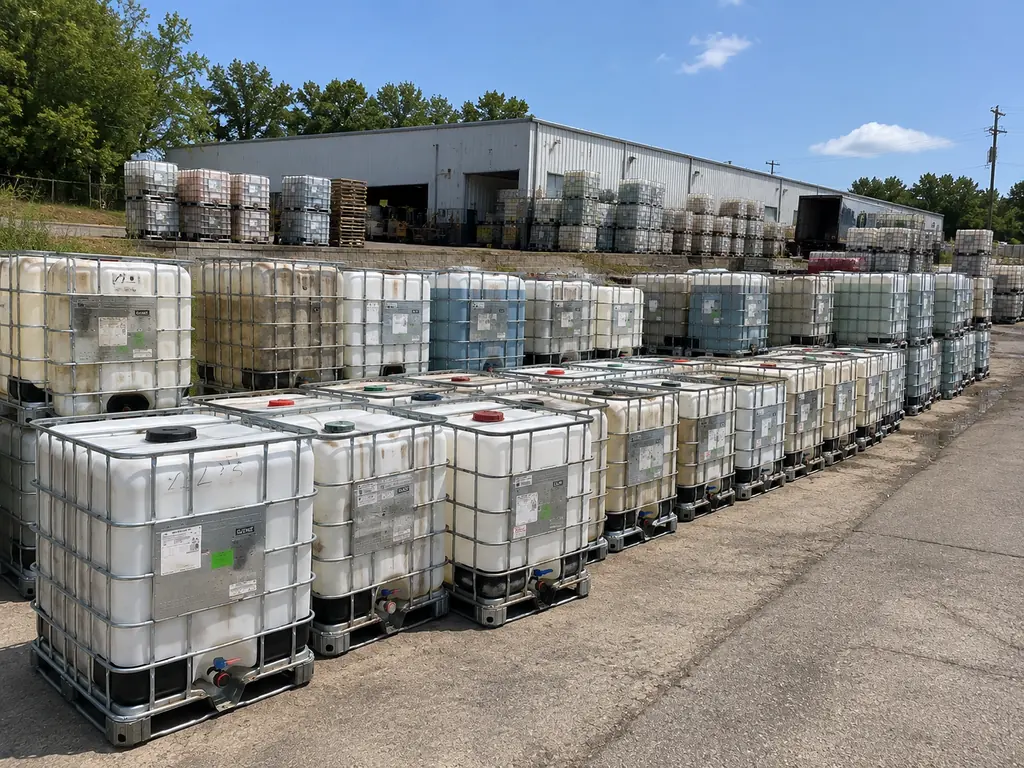
We grade used containers on a four-point scale. A is clear, square and documented — food or clean industrial. B is the standard reconditioned unit: sound, hazed or lightly stained, industrial history. C is non-potable: stained or patchy but structurally sound, for water, ballast and agriculture. R is rebottled — a brand-new bottle in a reclaimed cage, which sits alongside the scale rather than inside it. Buy the lowest grade that will do your job.
01The scale
Every container leaving this yard carries one of these letters, assigned at the grading station against these criteria, with a photograph attached.
| Grade | Bottle | Cage & pallet | Prior contents | Valve & fittings |
|---|---|---|---|---|
| A — Food | Clear, no staining, odour-neutral | Square, no repairs, sound pallet | One fill, edible, documented | New valve, new gasket, new lid |
| A — Industrial | Clear to light haze, odour-neutral | Square, minor cosmetic marks | Benign industrial, documented | New or rebuilt valve, new gasket |
| B — Standard | Hazed or lightly stained, sound | One or two straightened tubes | Industrial, known category | Rebuilt valve, new gasket |
| C — Non-potable | Stained, opaque patches, sound walls | Repaired welds, cosmetic dents | Mixed or unknown but benign | Functional valve, new gasket |
| R — Rebottled | Brand new, never filled | Reclaimed, straightened, re-galvanised | None | All new |
02Application matching
The most common expensive mistake in this trade is buying a grade higher than the application needs. The second most common is buying one lower.
| Application | Minimum grade | Why |
|---|---|---|
| Food or beverage ingredient | A Food or R | Migration and audit trail |
| Livestock feed or water | A Food or R | Same risk, same standard |
| Aquaponics with edible harvest | A Food or R | Root uptake is real |
| Cosmetics, personal care | A Food or R | Audit expectations mirror food |
| Light-coloured or fragranced product | R | Staining tints, odour transfers |
| Chemical blending and dosing | B | Compatibility beats provenance |
| Detergent, soap, car wash | B | Robust to residue |
| Vegetable garden rainwater | B | Known benign history required |
| Ornamental irrigation | C | Low consequence |
| Dust suppression, wash water | C | No product contact concern |
| Ballast, barriers, erosion control | C or yard run | Structural only |
| Cut-down planters, fabrication stock | Yard run | Cheapest sound container |
03Inspection
Every container is inspected at nine points before it gets a letter, and the inspection is photographed. If a unit fails on structure it goes to the granulator rather than to a lower grade — a cracked bottle is not a C grade tote, it is raw material.
The one non-negotiable is a sharp crease in the sidewall. HDPE that has been folded is permanently stress-damaged and it will crack there, usually when full. Everything else on the list is negotiable, repairable or cosmetic.
The full nine-point inspection, so you can run it yourself →
?Questions
No. Grading is a house scale at every yard, which is why comparing a 'Grade A' from one seller against a 'Grade A' from another tells you nothing. What you can compare is the underlying facts: prior contents, number of fills, bottle clarity, cage condition and what was replaced. Ask for those and the grade letter stops mattering.
Structurally yes — a bent cage can be straightened, a worn valve replaced, a dirty bottle washed. Historically no. Prior contents is a fact about the past and it cannot be changed by any process. The only route to a clean history is a new bottle, which is what rebottling is.
For ornamentals and lawns, C grade is fine and cheap. For a vegetable garden, insist on a known benign history — A or B. For livestock drinking water, treat it exactly like food and buy A grade with documentation or a rebottled unit.
Yes, as 'yard run' — unwashed, untested, sold as seen for fabrication stock, ballast and cut-down projects. We label them exactly that and we will not sell them for anything that touches product. They are the cheapest thing on the yard and they have entirely legitimate uses.
◆On the yard
»Keep reading
The four questions and the nine checks.
Where the grading scale is applied.
Why cleaning cannot change a grade.
One form, one human, one written quote. Totes to buy, totes to sell, a wash job, a recycling pickup — it all starts here.