Rebottled IBC totes
New bottle in a reclaimed cage — A-grade interior, B-grade price.
Product 01 · The workhorse
A reconditioned tote is a used tote that has been emptied, washed, rebuilt and pressure-checked until it will do a second decade of work. It is the cheapest honest way to move a thousand litres of anything, and it is the single largest thing our yard does.
Order desk
Quantity and delivery ZIP are what move the price. Tell us those and the grade you think you need, and we will confirm or talk you down to something cheaper.
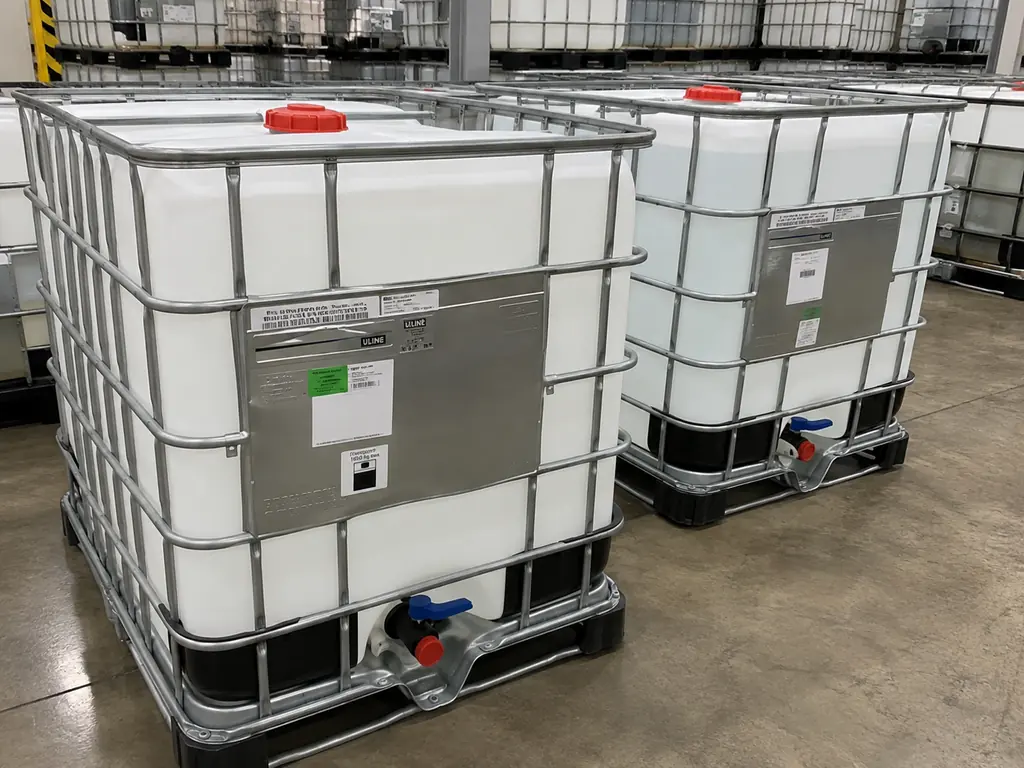
Reconditioned IBC totes are used 275 or 330 gallon containers that we strip, wash inside and out, fit with a rebuilt or new valve and cap, leak-test at pressure, and re-grade before resale. Expect $105–$219 depending on grade, size and volume. Every unit keeps its original UN-marked cage and bottle, so the container you receive is the container that already survived a first life.
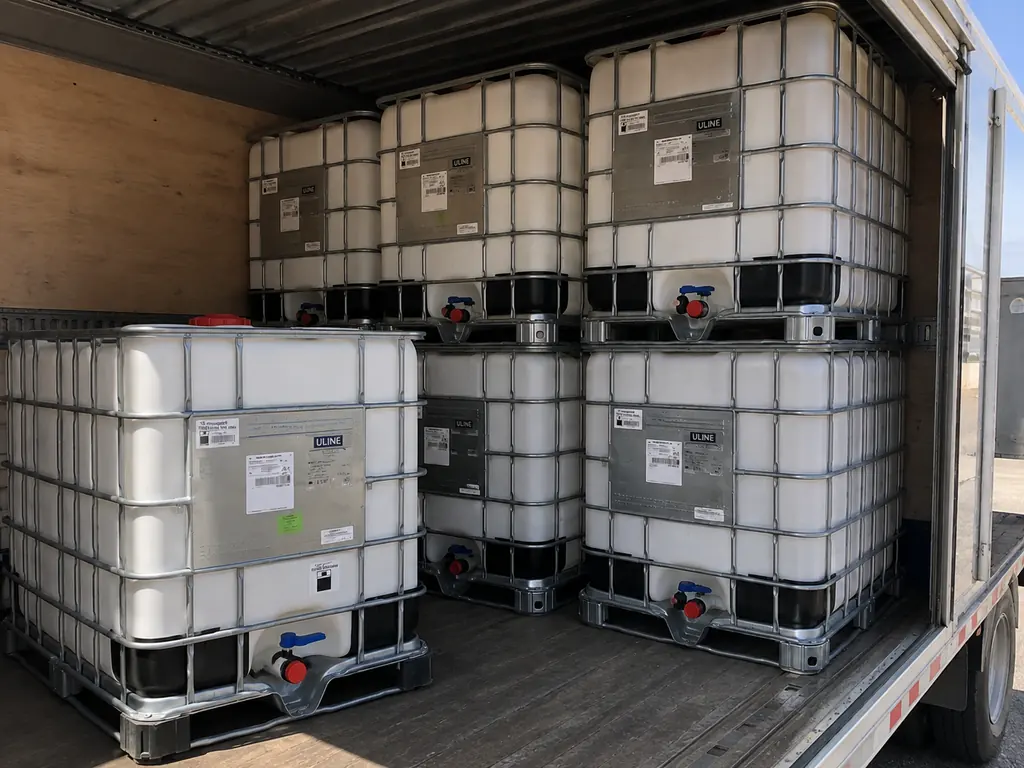
"Reconditioned" is an unregulated word in this trade, which is exactly why we publish our sequence. A tote that arrives on our yard at 7am on a Tuesday goes through eight stations before it earns a lot number, and any tote that fails a station goes to the granulator instead of the sales row.
Grade is not a marketing tier. It is a shorthand for four physical facts: how clear the bottle is, how straight the cage is, what was in it, and how the valve behaves. Buy the lowest grade that will do your job — a car wash does not need a food grade tote and paying for one is money set on fire.
| Grade | Bottle | Cage & pallet | Typical prior contents | Best for |
|---|---|---|---|---|
| A — Food | Clear, no staining, no odour | Square, no repairs, composite or plastic pallet | Corn syrup, juice concentrate, vinegar, glycerin, food oils | Beverage, ag feed, potable-adjacent storage |
| A — Industrial | Clear to light haze | Square, minor cosmetic marks | Surfactants, glycols, mild detergents | Chemical blending, dosing, clean water |
| B — Standard | Hazed or lightly stained, sound | One or two straightened tubes, sound welds | Lubricants, coolants, soaps, adhesives | Rinse water, wash bays, bulk transfer, construction |
| C — Non-potable | Stained, opaque patches, sound walls | Repaired welds, cosmetic dents | Mixed industrial, unknown-but-benign | Irrigation, dust suppression, ballast, erosion control |
Rebottled units sit alongside this scale rather than inside it: a brand-new bottle in a reclaimed cage, graded R. If you want an A-grade interior at a B-grade price, that is usually the answer.
The 275 and the 330 share a footprint, which is the detail people miss when they plan a rack. If your pallet positions already take a 48 × 40, a 330 drops straight in and buys you 20 % more volume for about 7 inches of extra height.
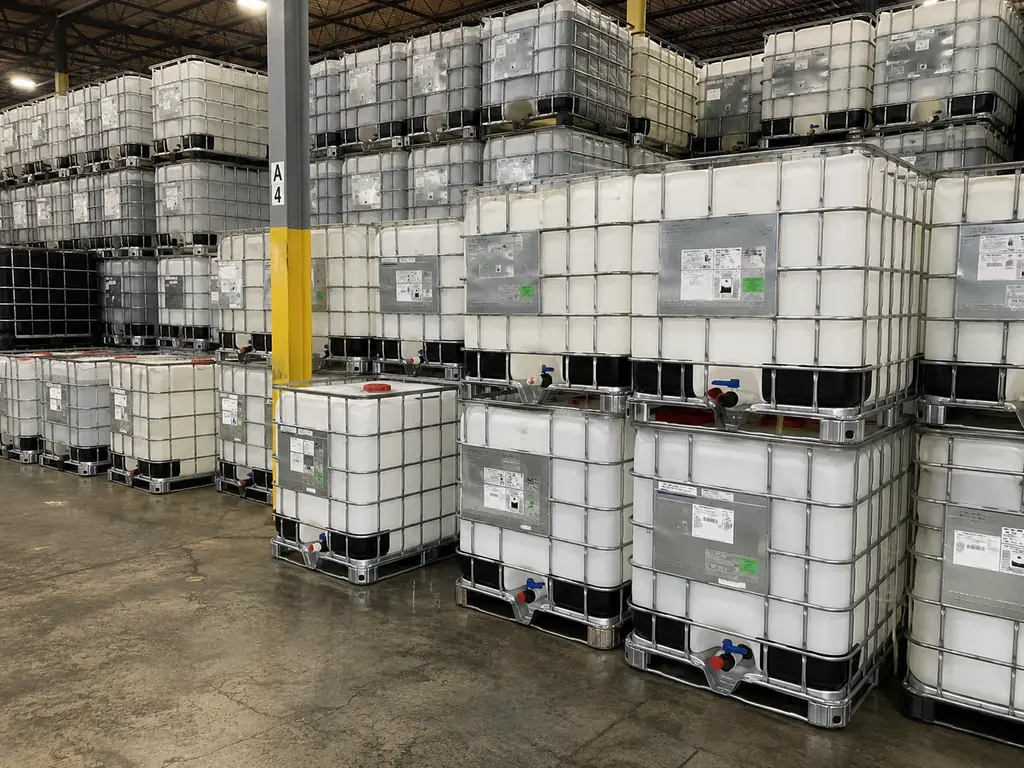
Totes are light and enormous, so you are always buying air freight rather than weight freight. That makes quantity the single biggest lever on landed cost — far bigger than grade.
| Configuration | 275 gal | 330 gal | Notes |
|---|---|---|---|
| Single stacked | 26 | 26 | Standard for filled or fragile loads |
| Double stacked | 52 | 52 | Empty only; 330s need 110" of door clearance |
| LTL pallet positions | 1–6 | 1–6 | Priced per position, not per pound |
| Hot shot / gooseneck | 8–14 | 8–12 | Same-day inside 200 miles of Austin |
Below six totes, LTL usually costs more than the totes themselves and we will tell you so. In that range it is worth asking whether you can collect from Montopolis Drive, or whether we already have a truck routed past your ZIP that week — we backhaul constantly and an empty leg is a cheap leg.
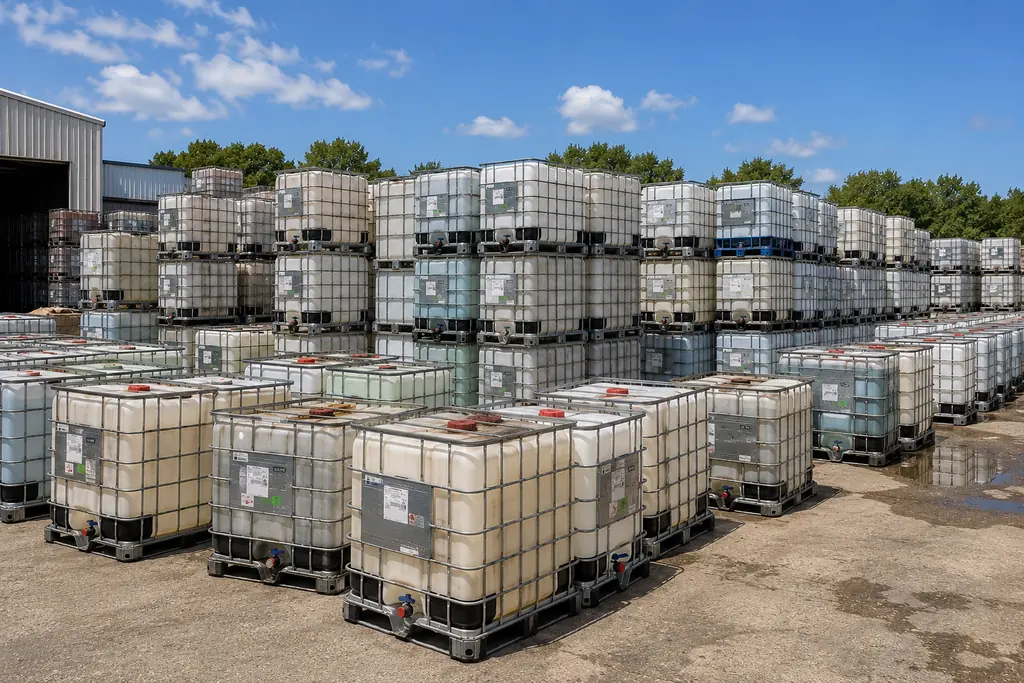
Second-hand containers do fail. Nearly all of it is predictable, and nearly all of it traces back to one of five things.
The tote is rarely the weak point. The gasket, the forklift driver and the sun are the weak points.
?Common questions
Only an A-grade food tote should ever go near potable water, and even then we recommend a dedicated potable-water build: new bottle, new valve, new gasket, food-grade lubricant. Reconditioned industrial totes carry residues at parts-per-million levels that are harmless in a wash bay and unacceptable in a glass. For rainwater used on ornamental plants, B grade is fine.
The 31HA1 mark stays on the cage plate, but a UN mark certifies the container as it was originally built and tested. Once a tote has been in service the certification for hazardous transport has to be re-established by a competent authority — that is a recertification service, not a resale claim. For non-regulated products the original mark is informative but not legally load-bearing. See our guide to UN markings for the detail.
Indoors, on a level slab, holding something compatible, a B-grade tote will do ten to fifteen years. Outdoors in Central Texas sun with no cover, expect three to five before the top surface chalks and the bottle loses impact strength. The cage almost always outlives the bottle, which is exactly why rebottling exists.
Yes, and you should. Every lot is photographed at grading — bottle interior through the lid, valve, cage, pallet and the data plate. We send the set with the quote. If the load that arrives does not match the photos, it goes back on our truck at our cost.
One. We will sell a single tote off the yard for pickup. For delivery the economics start working at six and get good at twenty-six, which is a full single-stacked van.
»Keep reading
New bottle in a reclaimed cage — A-grade interior, B-grade price.
The full A / B / C / R definitions with photographs of each.
We recondition customer-owned fleets on a per-unit basis.
One form, one human, one written quote. Totes to buy, totes to sell, a wash job, a recycling pickup — it all starts here.